Monday, April 23, 2012

I am a Zionist

I am a Zionist, a liberal Zionist, a “beautiful soul” as my detractors would have it, and “I will not die but live” (Psalm 118:17) because my mission is too important. I am an heir to that divine command, “Walk in my ways and be innocent (Genesis 17:1).” And I take my inheritance seriously.

My identity was ascribed in Egypt and assumed at Sinai. Not only did I chose to be a Jew, I was also labeled one, but I will not allow labels to tell me who I am; not by Pharaoh, not by the Romans, not by the Spanish, or even the Nazis. I will continue to “choose life (Deuteronomy 30:19),” as my earliest teachers prescribed, and I will do so from a position of independence, not fear. I am a Jew.

I will not make idols out of land, nor put ideals before human lives. I am a Jew.

I will not censor, nor deal falsely, nor lie to cover my shame. I am a Jew.

I will rebuke my fellow and try not to transgress in the process because I am bound to all of Israel. I am a Jew.

I shall not defraud my neighbor, nor rob him of his land or his human rights. I am a Jew.

The wages of my foreign laborers will not remain with me all night until the morning, nor shall I exile his children from the land of their birth. I am a Jew.

I shall not curse the deaf, nor put a stumbling block before the blind, because I seek honest discourse with just outcomes. I am a Jew.

I will not stand idly by as the blood of my neighbors is shed by my own countrymen. I am a Jew.

I will not hate my brother in my heart; and will reason with my neighbor, and not allow sin on either account. I am a Jew

I will not avenge, nor bear any grudge against the children of my people but shall continue to love my neighbor as myself. I am a Jew

Monday, April 16, 2012

Bully movie embraced by BBYO, Kudos! What about the rest of us?

I read this morning about the adoption, by BBYO, of the noble goal to have loads of Jewish teens see the Bully movie, and I think that is wonderful. It did, however, make me think about the rest of us. I'm thinking specifically about Peter Beinart's recent book, The Crisis of Zionism, which has made us all come to the table and discuss the issues surrounding our embrace of Israel. Unfortunately, it seems that everytime we have a difference of opinion these days we end up calling those we differ from either Nazis or self-hating Jews.
As this is the time of the counting of the Omer, and we are mourning the loss of the 24,000 students of Rabbi Akiva who died in a plague which is reported to be the result of in-fighting (Yevamot 62b), I would like to take this space to wish for my people the following prayer from Rabbis for Human Rights.
May I recognize my failure to understand those who oppose me. May I be able to look at the face of my enemy and see the face of God. May we all be instruments of peace.

Tuesday, April 10, 2012

If I was Ozzie Guillen

The big irony of the Ozzie Guillen-Fidel Castro episode is that it happened over easter weekend. Please don't take this in the wrong way, but it sounds like Jesus got his and now Ozzie is the new sacrifice. Of course, Jesus wasn't sacrificed. He was censored in the strongest sense of the word, and now it is Ozzie's turn. Unfortunately for him, the anti-Castro Cuban community is almost as strong as the 1st century Roman empire.
One major difference between these two examples is that Jesus had a soft and gentle message for people living under Roman oppression, while Ozzie was insensitive to a bunch of angry and powerful emigres who occupy the city where he manages a baseball franchise. But what was so bad about Ozzie's message? If I were Ozzie Guillen, I would have responded much differently.

Members of the press, Marlins fans and people of the western hemisphere, I want to take this opportunity to apologize for my hurtful comments. Sometimes I say things that I haven't thought through well enough, and clearly I have hurt some feelings, which I never intended to do. I didn't come here to Miami to hurt feelings. I came to bring pride to a city with millions of Latin Americans, like me. I am a baseball manager, not a politician or historian. I don't know enough about Fidel Castro to have made comprehensive comments about the man's life. That said, my comments were about his longevity. He has managed to stay in power, under extreme odds, for over half a century. I couldn't even stay with the White Sox for a decade, and I brought them to the World Series.
If I were really bold and had brought Miami to a World Series before facing this firing squad, I might add...

Since I now have to take responsibility for my comments, I would like to take this opportunity to teach something about this man that you have vilified. Fidel Castro came to the United Nations, upon his ascension to power, and promised full literacy for his people within a year. Before he came to power, just over half of all Cubans could read and write, but within one year of his promise, 99 percent of Cubans were literate. Also, despite the fact that wealth was redistributed by force, Castro created, universal health care for Cubans, something tens of millions of Americans don't have. Today, in Cuba, all children go to high quality public schools. All citizens have housing, employment and food. They may not enjoy the freedom to amass great wealth, but they all have the freedom to go to bed with food in their stomachs. So while I can understand the pain of those who left their country and their wealth because they were not willing to share it with their fellow country men and women, I completely resent this effort to stifle my freedom of expression, the constitutionally guaranteed right that makes this country great. I didn't exercise my freedom with the intention to hurt, and I am sorry for any pain I have caused, but if you don't want to watch the baseball team under my management because you want to make a political statement, that's fine, just don't be so selfish as to try to determine the future of Miami baseball based on your political baggage. That behavior has no place in any country, especially this one.

Sunday, January 15, 2012

Some thoughts about 'Why should Jews care about the rights of Israeli Arabs?'

In his book about the life of Mahatma Gandhi, Louis Fisher (1950) writes,

"Hitler," Gandhi said, "killed five million Jews. It is the greatest crime of our time. But the Jews should have offered themselves to the butcher’s knife. They should have thrown themselves into the sea from cliffs... It would have aroused the world and the people of Germany... As it is they succumbed anyway in their millions."

This is a very difficult quote to read, and it needs parsing out. I am guilty of previously not doing the work necessary to reach Gandhi’s intention and have taught this as a call for Jews to go, “as sheep to slaughter.” I think I have done my students a disservice.

Today I am reading this quote in the context of an article I read by Rabbi Sid Schwartz (JTA, 1/12/2012) titled Why should Jews care about the rights of Israeli Arabs? I can already imagine some of my readers jumping from their seats in anger and accusing me of equating between the Shoah and the treatment of Israeli Arabs. This knee-jerk reaction is one of the greatest threats to the Jewish people. Human and civil rights are core Jewish values, and the Shoah may have been one of the greatest violations of these rights, but we need to discuss all violations of these moral and ethical imperatives on the same spectrum. It does no good to stigmatize every comparison to the Shoah, just as it does harm to hyperbolize the comparisons, as was recently the case in ultra-orthodox demonstrations in Israel where demonstrators dressed their children as concentration camp prisoners.

One small tangent; my teacher Rabbi David Wolpe has suggested, quite overtly, that the Cambodian genocide was the worst of the twentieth century because the world new it was humanly possible and did nothing to prevent it.

Rabbi Schwartz suggests two basic reasons for Jewish care for Arab rights in Israel, their humanity and Israeli democracy. As Humans, Israeli Arabs, just like the Sudanese refugees or Taiwanese foreign workers in Israel are made in the image of God, according to Jewish tradition. For this reason alone, their basic rights and dignity should be upheld. But dignity is a broad term that is rarely unpacked in any semblance of a serious definition. Rabbi Schwartz speaks of the injustice of the fact that 20 percent of Israel’s population accounts for 1 percent of its gross domestic product. He also speaks of inequality in municipal and educational services and in employment opportunities. I know some of my readers will stop here and say that the Israeli Arabs don’t serve in the military, thus they don’t share in the burden of the state’s maintenance. In fact, more Arabs now serve in the IDF than ever. More importantly, ultra-orthodox and secular Jews who avoid the draft are not punished with the same lack of services found in the Arab sector.

When Rabbi Schwartz addresses the issue of democracy, he also provides several examples. He states that our independence, as written in Ben Gurion’s Proclamation, calls for equal rights of all residents.  

[I]t will ensure complete equality of social and political rights to all its inhabitants irrespective of religion, race or sex; it will guarantee freedom of religion, conscience, language, education and culture; it will safeguard the Holy Places of all religions; and it will be faithful to the principles of the Charter of the United Nations.

Ironically, this declaration of independence does not call for a democratic state, and I wonder if this has anything to do with the possible oxymoron of calling Israel a Jewish democracy. Interestingly, one of the greatest assertions of democracy of all times, Lincoln’s Gettysburg Address, which includes the famous, “government of the people, by the people, for the people, shall not perish from the earth” also does not mention democracy.

Now to Gandhi’s quote, in my very round about way. Avishai Margolit, the Israeli philosopher, in explaining the difference between morals and ethics, says that ethics guide thick relations between human’s whose lives are interconnected, even Palestinians and Israelis. This is why we have an ethics of war. But Morals guide our behavior when the stakes are significantly lower. Morals, according to Margolit, guide our behavior, specifically, because the stakes are low or non-existent. We are morally compelled because without morals, we would not help strangers.

Why does Gandhi say, “Jews should have offered themselves to the butcher’s knife. They should have thrown themselves into the sea from cliffs... It would have aroused the world and the people of Germany.” because Gandhi believes in the power of morals to arouse the ire of regular human beings to pursue justice and dignity for one another, even when the stakes are low. Gandhi’s appeal is moral in the same way as Dr. Martin Luther King’s claim, “Injustice anywhere is a threat to justice everywhere.” We have morals because ignoring injustice is corrupting. Gandhi doesn’t want Jews to die. He wants their death to be meaningful. He believes that since they will be dying anyway, they might as well make it a sign for generations to come.

This understanding of Gandhi reminds me of the dispute between Ben Padat and Rabbi Akiva regarding a flask of water that can save one of two people’s lives. Rabbi Akiva believes that one should surely drink the water to save his own life because a life has no value if it ends. Ben Padat believes differently. He is concerned with what his life will mean if he chooses his own life over his friend’s. Ben Padat is concerned with the kind of person he will be if he gets to live at the expense of his friend. In a sense, Gandhi is like Ben Padat. His argument is that if you have to die anyways, you might as well make your life a sign of how terrible humans can treat one another. He doesn’t suggest that Jews fight their oppressors because he doesn’t believe in becoming like them. This is a difficult decision for any human. In my worst nightmares, I am forced to live with myself after having to be unfaithful to my ideals. It would be nice if I could live this standard in real life, but it is very difficult. Life is about compromise, but Ben Padat and Gandhi believe that death doesn’t have to be.

In Israel, treating Arab Israelis with the dignity they deserve as fellow citizens is not nearly as difficult as people make it out to be. The mistreatment is about racism and misrepresented as self defense or “me first.” Many Israeli Jews try to apply the teaching of Hillel, “If I am not for myself, who will be for me.” But this approach is dishonest. The best way for Jews in Israel to be for themselves is to be for their weakest minorities. The absence of this form of democratic vigilance is what has led to the huge decay in Israeli democracy from the misogynistic behavior of the ultra-orthodox to the anti-immigrant and refugee fervor that has swept much of the nation. In the words of the great German pastor, Martin Niemöller,

First they came for the communists, and I didn't speak out because I wasn't a communist.
Then they came for the trade unionists, and I didn't speak out because I wasn't a trade unionist.
Then they came for the Jews, and I didn't speak out because I wasn't a Jew.
Then they came for the Catholics, and I didn't speak out because I was Protestant.
Then they came for me
and there was no one left to speak out for me.

If we Israelis and Jews don’t start understanding King’s decree that “Injustice anywhere is a threat to justice everywhere.” And that “government of the people, by the people, for the people, [must] not perish from the earth” we will simply lose our value as a unique nation with the mission of being a vehicle for God’s blessing. This would be worse than any existential threat that would force us to steal the flask and drink the water without concern for what we might become.

Friday, January 13, 2012

Ruminations on BDS, despite the risk of marginalization by my people.

Even the mention of BDS (boycott, divestment, sanctions) can get a guy in trouble in my community. Cecilie Surasky, a leader in the group Jewish Voice for Peace was bumped from a national Jewish Heroes competition for her belief that this was the best way to get Israel to reach a final status agreement with the Palestinians. Cecilie was polling very strong at the time she was censured. Clearly someone with power didn’t appreciate the heroisms of Cecillie’s work. I wonder if the same would have happened if she were a very righteous Jews for Jesus or a halacha abiding haredi who makes his wife sit in the back of the public bus and spits on what he deems immodestly dressed young girls.
My teacher, Donniel Hartman, wrote an interesting dissertation that was turned into the book The Boundaries of Judaism, in which he explores the making of borders in Jewish society. The meta point of the book is that Jews have always negotiated these borders and even tolerated many deviant behaviors within their realm. The rabbi where I work, Harold Schulweis, even suggested that these boundaries include Jews who believe in Jesus. I suppose that I am less generous that some. I would certainly protect a Jew for Jesus if he were attacked by neo-Nazis for being a Jew, but I don’t know that I would love to bring him into my religious community. The same applies even stronger to settlers who attack Israeli soldiers or members of the Israeli Knesset that give away state secrets to assist settlers in their vigilantism. I suppose I would defend them from anti-Semites, but I certainly do not want to build a society with them.
I have some friends in Israel who will not do their reserve duty in the occupied territories because they do not want to defend the settlers or support the occupation. In general, I have more respect for those among them who spend their time in military prison, because they want to uphold the system but not participate personally, than those who find a way out of the service to strictly meet their personal needs. Faced with the possibility that my son will have to defend settlers, I am not so sure I want him drafted into the IDF, which is a possibility.
On the other hand, I firmly believe in democracy. As Churchill said so bluntly, “It is the worst form of government except for all the others that have been tried.” So what does it mean to be a democratic Jew and an Israeli? And how does this tie to BDS?
I have zigzagged between Israel and America my whole life. My birthday is February second, which is ideal for a person who lives in my two worlds. In American, where the month comes before the day, I write 02/02, and in Israel, where the date starts with the specific day, I also write 02/02. In this I am fortunate. I am also fortunate to have an alternative when I am not comfortable participating in my country’s decisions. Being American is easier for me than being Israeli because I didn’t choose it. My parents brought me into the world here. If this country enters an unjust war or elects a president I disagree with, it doesn’t feel like a reflection on me. When Israel makes choices I have great difficulty with, I feel uncomfortable with my decision to become a citizen.

Regarding BDS, Boycott, Divest and Sanctions, this is an outsider movement. Even if Jews support it, the effort is to use external power against Israel to force it to end the occupation. The good thing is that this is a non-violent effort, although it is not completely resistant to scrutiny. Attacking companies that benefit from the occupation, like the contractors that build in the West Bank or the financial institutions that bankroll them is one thing. What about companies that grow food in this disputed land and hire Palestinian labor. Isn’t there some violence in attacking a person’s source of income. I am not a pacifist. Sometimes violence is an appropriate response. I disagree with Ghandi, who said Jews should have quietly submitted to Nazi genocide. I also don’t think that BDS is a smart tactic.

BDS supporters generalize about their target. Ben Gurion University is run by a sympathizer for BDS, yet his institution is the target of the boycott. Bar Ilan University is generally not a friend to leftist causes. Its most famous student was the assassin who killed our prime minister at a peace rally in Tel Aviv, which was followed by the university putting his face on the cover of their annual report. The difference between me and those who believe in BDS is that I believe in my cause and my ability to change things for the better without resulting to force. I believe in honest, open intelligent discourse and the capacity of my fellow human beings to pursue the just and merciful path.

My friend Ed asked me to come hear a Palestinian author speak about his book on BDS. I was a bit nervous about the stigma that the community would try to put on me for going, but, instructed by my Jewish values, I went. The Talmud tells us why we normally follow in Hillel’s ways when Shammai’s were also “the words of a living God.” The Bat Kol, the heavenly voice said that we follow Hillel because of his modesty and because he represents the other sides argument before his own. I needed to hear the BDS argument from the Palestinian writer and from Cecilie Surasky of Jewish Voice for Peace before I could continue to contend that BDS is ultimately not a good method for achieving a lasting peace.

The day before the lunch, I reflected on my participation in the divestment movement in South Africa. Clearly, black South Africans were calling for support of the boycott. The main difference was that my support had no ethical stakes in the matter. The Israeli philosopher, Avishai Margalit, defines the difference between ethics and morals by the type of engagement. He says that ethics are guided by thick relations while morals are guided by thin relations. Whatever happened in South Africa was going to stay in South Africa. My relationship to Apartheid was thin, which made it a moral issue for me. This is like Martin Luther King’s claim in the Letter for the Alabama Jail that “Injustice anywhere is a threat to justice everywhere.” But my relationship to the Palestinian-Israeli conflict is thick. We need ethics to guide the interaction between our two nations. Ethics is an internal discussion between the parties to the conflict and within the individual parties. BDS is an appeal to go outside to accomplish change. Sometimes it is necessary, but not until all efforts to come to internal agreement have been exhausted. This is why I remain in Peace Now, a movement that aggressively tries to facilitate internal Israeli and Jewish discussion by researching and exposing violations of standards we set for ourselves.
The new candidate/party for the Israeli Knesset, Yair Lapid, writes about two Israel’s. In my Israel and his, we strive for a country that tries to manifest the goals articulates in Israel’s most beautiful political proclamation, its Declaration of Independence. “It will be based on freedom, justice and peace as envisaged by the prophets of Israel…”

The most troubling thing I heard at the luncheon, however, was not from the Palestinian author. It was from Cecilie Surasky, who told me about the terrible violence in the territories and Israel against Palestinians. Mind you, there should be no place for institutionalized, cultural or personal violence against any human being, but the way Ms. Surasky reported it to me, she was being relativistic. Israeli violence, in her mind, is unbearable and the top priority for Jews to say no. I agree that violence perpetrated by my people is what I need to stop first. It is also the violence I have most control over. But there was something very unsettling about a Jew being more critical of Israeli Jewish violence which is relatively less than the violence perpetrated in Syria by a leader against his own people or the violence in Sudan.

I think it is great that Cecilie Surasky and Jewish Voice for Peace stands up to the occupation. I think it is very sad that they and their Palestinian counterparts in BDS have given up on discourse, and I am very worried about the introduction of relativism into the argument. I could have (and now I am) explained that the Palestinian speaker got his MA at my alma mater, Tel Aviv University, which is a very enlightened institution. And that there are many of these points of Light in Israel and they need to be nourished, not starved through academic boycotts. I didn’t want to go there, but Cecilie Surasky’s relativism opens this ugly pandora’s box.

During the writing of my dissertation, I went to Ramallah many times; an illegal act for Israeli Jews. When I would come back, my friends would ask me why my Palestinian friends don’t speak up against Hamas or speak out against attacks on civilians. I have never had a good answer for this. Both Cecilie and the Palestinian author said that I was blaming the victim. I am not so sure. If Jewish Voice for Peace is so ready to take responsibility to end Jewish and Israeli behavior in the territories why not expect that of everyone. “Injustice anywhere is a threat to justice everywhere.”

I’m glad I went to lunch and didn’t fear the wrath of my community for legitimizing fringe forms of Jewish dissent, but after listening and acquiring the knowledge to present the other side, I am still not sold. BDS is not a good Jewish response to the occupation. It may be valid, and I would never censure Jewish Voice for Peace, but this is not a strategy that believes in the good of humans or the power of reason to overcome injustice.

Friday, December 23, 2011

Hanukkah: A Time we made for Optimism


Truth be told, Hanukkah is a strange holiday. It is framed as the commemoration of the victory of the Macabees over the Seleucid King Antiochus Epiphanes and his forces, but it is really about a zealous family that won a Jewish civil war and then became so delusional by its own power that it self destructed and fell to the Romans. It is also framed as the holiday of the miracle of the oil that burned for eight days at the rededication of the Temple in Jerusalem. And, during the time of the Winter Solstice, people all over the northern hemisphere celebrate light, which is why Hanukkah is the festival of Lights, thus the rabbinic greeting Chag Urim Sameach – Happy Lights Holiday.

While each of these stories warms our hearts, spinning the nice parts of our history, believing that God intervenes in history and celebrating light in its absence, there is something wildly absurd and beautiful about it. The question I’d like to raise is whether this is an inherently good thing. Is it good to delude ourselves about our historical narrative? Is it beneficial for us to believe that there is someone in heaven looking out for our interests? Should we really celebrate that thing we long for so badly when we are at our furthest moment in time from its presence in our lives?

The rabbis seem to have created the miracle of the oil with good insight into human psychology. Here they were defeated in the promised land with the potential of exile hanging over their heads, and they offer a story that fits our psyche perfectly; someone up there is looking after you and can intervene to your benefit. I can’t think of a better suited epistemology for a battered people who have lost all semblance of power and control over their lives. Kudos to our sages.

Ben Gurion, Israel’s first prime minister, however, was also prophetic in his resurrection of the Macabee story. In those days, in this time, there were tough Jews who lived in this (that) land, and “We can be like them.” Ben Gurion left the continuation of the narrative on the cutting room floor.  I’m not sure that this was as clever as the rabbis. Ignoring the addiction to power and its negative impact on Jewish society has not been, “good for the Jews.” Instead of learning from the zealotry of Mattathias and the Hasmoneans, we should take a lesson from Hillel about humility and presenting the argument of our adversaries before our own. What Israel can use now is a lesson about light, which the last message of our holiday.
Light has this incredible presence. You don’t actually see it, but it illuminates what is present in your path, thus it removes obstacles. The early pioneers of Israel were brilliant about removing those stumbling blocks that prevented our people from achieving our collective goals for humanity; justice and peace. The founders of Israel sought to create a great society that would shed a light onto the nations. Somehow, along the way we decided to become a “normal” country. Normal countries don’t share light, nor do they seek peace and justice. They do what President Richard Nixon was, at least, honest enough to admit, “We’re in it for national self-interest.”

National self interest is not the Jewish way. Our aspirations are for the world God created, not merely ourselves. Again, returning to Hillel, “If [we] are not for ourselves, who will be for us? If [we] are only for ourselves, what are we? And if not now, when?” Hanukkah is a time we created for optimism, and I am full of hope that we can take inspiration from this holiday to return to our Jewish dream; peace, justice and our role as a light for the nations.

Thursday, September 29, 2011

Thoughts for the 2nd day of Rosh Hashana


There is a great Jewish legend about a shoe maker who comes to the rabbi and asked if he can learn Talmud. The rabbi says to the shoe maker, “To study Talmud, you must think like a scholar.” He then proceeds to share a story.
“Two criminals break into a house through the chimney. When they climb out of the fireplace, one of them has shmutz all over his face.” The rabbi then asks the shoe maker, “Which one washes his face?”
To this, the shoe maker quickly replies, “The one with the shmutz.”
“You see,” says the rabbi, “you are not thinking like a Talmud scholar.”
At that moment, a light bulb goes off in the shoe makers head and he replies smugly, “I get it! The one with the shmutz sees the one with the clean face and can’t imagine himself being dirty, but the one who sees his partner with the dirty face must imagine the same about himself, so he washes his face.”
“Oy!” Says the rabbi. “Did you really believe that a man can slide down a chimney and not get shmutz on his face?”

I love this story because it helps illustrate the most important things about being Jewish; one was the title of an Apple computer advertising campaign several years ago, the other the profound message of my hero Lenny Bruce.
Years before the iPad and iPhone, when Apple wasn’t the wealthiest company in the world, and their market share was not what it is today, they tried appealing to the fringes by asking us to “Think different.” Judaism has had a monopoly on this simple command as far back as Abraham. In a world of pagans, in a world where people are willing to trust their morality to statues and a plethora of Gods, Jews said, “Think different!” and brought us Elohim, one God, to help avoid the possibility of dissonant sources of morality.
When you think about it, “Think different!” is an amazing request. It asks us to not settle for the status quo, to not be happy with the easy answers, to not get stuck in our old routines. “Think different!” is our way of saying, we are a people of hope, a people of possibility, a people who can repair the world; all we have to do is put our minds to it.

The message of Lenny Bruce is truly more profound. It says, be irreverent. Don’t respect holy cows. Fight the power! Don’t believe everything you hear.
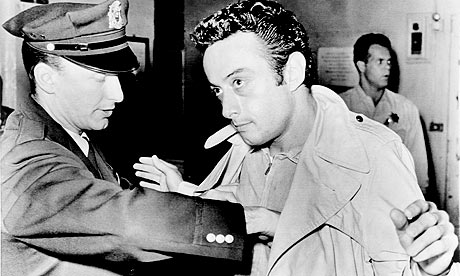
Lenny lived his Torah. When the police started arresting him for “obscenity” in his performances, He didn’t censor himself. He turned to his friend, the great comedian Steve Allen, and asked for a meeting with his father in-law, a missionary reverend. He wanted to understand why talking about “the first commandment God gives in the Bible, ‘be fruitful and multiply,’ is obscene.” He couldn’t understand the hypocrisy of his puritanical accusers. The same is true of our rabbis. When they were confronted by the Bat Kol, the voice of God, who told them that they were wrong and the lone Rabbi Eliezer was right, in a matter about the kashrut, the kosherness, of an oven, the rabbis refused to capitulate. They declared, “[The Torah is] not in heaven.” It isn’t God’s anymore. It’s theirs. Ours. And we must determine how we understand it. This is also the irreverence of Rabban Yochanan ben Zakai who, when asked what to do if the Mashiach comes while people are planting trees, said, “finish planting the trees and then go greet the Messiah.”

Every second day of Rosh Hashana, I miss the irreverence of Abraham who had the chutzpah to ask, “Shouldn’t the judge of the world act justly?” Why did you lose your irreverence and obey when you thought God asked you to sacrifice your son? Why didn’t you “Think different!”
This Rosh Hashana, it is my hope that we find it in ourselves to act Jewishly and be people who can study Talmud. We need critically literate Jews if we are going to make the world a better place, and we need the chutzpah and irreverence of our forebears to go beyond the status quo. This is what the judge of the world expects of us, and we cannot afford to dissatisfy Her.